

Socrates is in prison awaiting execution, and he is doing something he had never done before: writing poetry. When his friends ask him why, he explains that he has always had a recurring dream, a voice that told him to “cultivate and make music” (Phaedo 60e).
Socrates had always assumed that by “music” the dream meant philosophy, the highest form of music — but
after the trial, while the festival of the god delayed my death, I thought that in case the dream was telling me to make music in the common sense, I should not disobey it, but compose. (Phaedo 60e–61b)
For his entire life, he had needed no other music than philosophy. Reason and song were one and the same thing. But something happened at the trial that pried them apart — something that required obedience.
So he began, in his cell, composing a hymn to Apollo, the god whose festival had fixed the day of his death.
What was that something? And why should poetry be distinct from philosophy?
Where it began: the Euthyphro
The Euthyphro is the dialogue that sets the scene for the trial. Meletus has brought his charge — Socrates corrupts the young and does not believe in the city’s gods — and Socrates, on his way to answer it, falls into conversation with Euthyphro on the courthouse steps. Here the questioning is still alive, and Socrates is still himself when he asks Euthyphro what piety is.
The reason he asks is plain. Euthyphro has come to prosecute his own father for murder, certain he knows “what the gods think about piety and impiety” (Euthyphro 4e–5a), and Socrates is about to stand trial for not knowing it — or rather for refusing to pretend he does. Both men have come to the mother-city against a father: Euthyphro against his own, Meletus against Socrates, the new father-figure of the young.
So when Socrates asks what piety is, he is asking the question his own life now turns on. He professes ignorance, of course, and suspects this is why he stands charged with impiety and corrupting the young: that he cannot believe those stories about gods feuding and castrating their own fathers (Euthyphro 6a).
But Socrates grants that Euthyphro must be very wise — wiser, even, than the gods he imitates. And so the dialogue proceeds, until it is plain that Euthyphro knows nothing at all. The elenchus does what it always did: it takes a man who thinks he knows, and leaves him, like Socrates, knowing that he knows nothing.
Who improves the young: the Apology
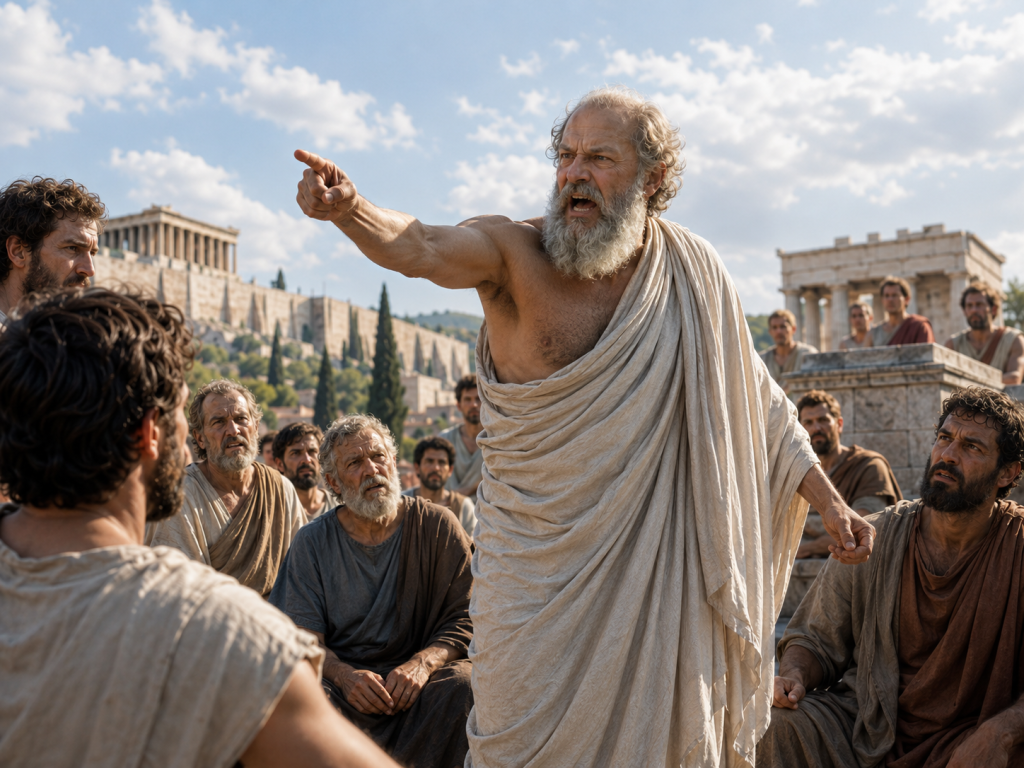
When Socrates went into court, the humble, ironic questioner gave way to a proud father who compared himself to Achilles and dared the jury to kill him. Turning the method on his own accuser, he asked: if I corrupt the young, who improves them, Meletus?
“The Laws,” says Meletus. (Apology 24d)
But the Laws are no one — Socrates presses — they cannot teach or raise a child. So Meletus retreats: “The judges, Socrates, who are present in court.”
“What, all of them, or some only and not others?” — asks Socrates.
“All of them” — until Meletus is claiming that the whole of Athens improves the young, and Socrates alone corrupts them.
So, “the Laws” are the faceless crowd, the city itself, which threatens the one individual who thinks for himself about piety and impiety, justice and injustice:
It is not Meletus or Anytus who will convict me, but the slander and envy of the many, which has destroyed many good men before, and will, I think, destroy many more. (Apology 28a)
The cell: the Crito
After Socrates’ indictment of the city, the verdict is passed, and the sentence is — not surprisingly — death. But the city’s sacred ship has sailed to Delos, and until it returns no execution may take place — that would be an impiety.
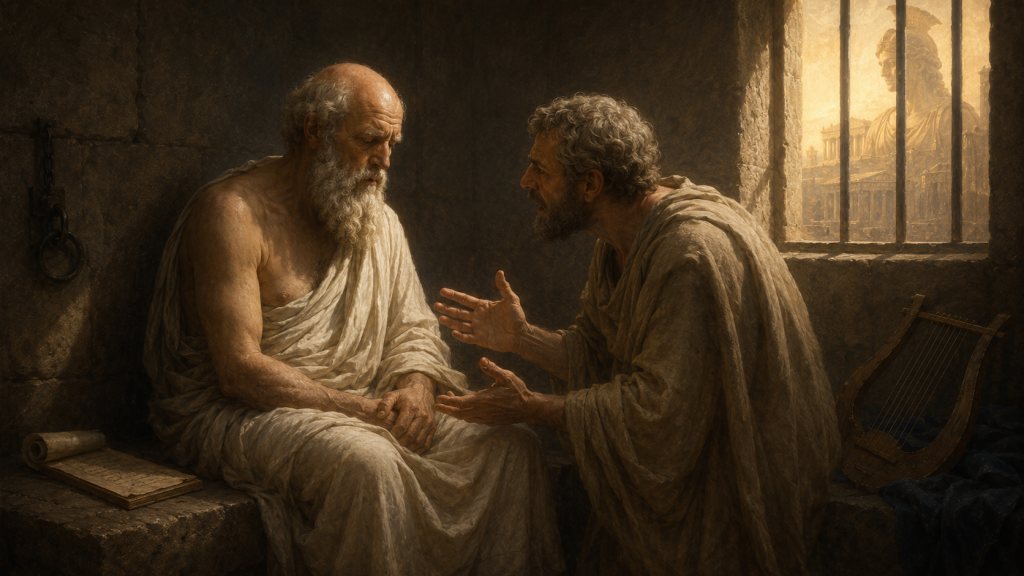
So Socrates waits in his cell. Before dawn, his old friend Crito slips in. He has bribed the guard; a ship is ready, a refuge arranged abroad. There is still time to escape. But Socrates has not changed; he still needs to discuss the justice of such a decision.
And he begins with the rule he has always lived by:
We must not value what the many say of us, but what the one who understands justice will say. (Crito 48a)
He himself is the man of understanding. The city-state has no authority. The door is open, and on his own principle, he should walk out.
Yet after much deliberation, he asks Crito whether,
in leaving the prison against the will of the Athenians … do I not wrong those whom I ought least to wrong? (Crito 50a)
Crito does not quite know what he means. So, suddenly, Socrates summons the Laws of Athens and lets them speak — the same Laws, the same crowd, he had just shown to be the least concerned with improving children. And yet they claim to have raised him: they married his parents, educated him, trained him “in music and gymnastics” — and so he is their child, and owes them obedience unto death.
The Laws speak for the remainder of the dialogue, until Socrates admits:
This, dear Crito, is the voice which I seem to hear murmuring in my ears, like the sound of the flute in the ears of the mystic; that voice, I say, is humming in my ears, and prevents me from hearing any other. (Crito 54d)
The “mystics” were the Corybantes, the attendants of Cybele, the Great Mother goddess, who danced to her flutes until they could hear nothing else.
These are the limits of the Socratic elenchus. The man who would pay for a refutation is now unable to listen. He asks Crito whether he wishes to say anything against it. But Crito is overwhelmed; he has nothing to say.
The two heroes and their crafts
As mentioned, Socrates did not only philosophize at the trial. He also compared himself to Achilles, the hero of the Iliad, who put honour and the will of the gods above his own life (Apology 28b–d).
It is worth remembering who stood behind that choice. Achilles’ mother was Thetis, the sea-goddess. It was she who armed him and cried for him. It was she who spoke the prophecy — that if he killed Hector, his own death would follow close behind. This is the story Socrates reached for, at his trial, to describe his own drama.
And it returns to him, in the Crito, as a dream. A beautiful woman in white had come to him: “The third day hence to fertile Phthia shalt thou go.” It is the line Achilles speaks in the Iliad, when he threatens to abandon the war and sail home — to the long, quiet life his mother had set before him, the alternative to dying young at Troy.
But as so often in Greek myth, Achilles’ destiny could not be escaped — and indeed “Phthia” sounds like the Greek word for perishing. The dream offers Socrates the homecoming Achilles was offered. Achilles refused it; Socrates does not. Both perish.
That is not philosophy’s voice; it is poetry’s.
Socrates had always known the danger. He told the court that the just man, to survive, must keep to private life, for the city kills whoever fights it in the open. Yet he had spent his whole life carrying his questioning to the city anyway — to the mother who would kill him for it. The poetry was always in him; the trial only brought it to the surface.
What is piety?
In the events leading to Socrates’ death, reason had reached a forbidden knowledge.
It had all begun on the steps of the court, with a question he put to Euthyphro and never answered: what makes a thing “pious” and loved by the gods?
Here Socrates was still asking, but the questioning was already reaching the sensitive place where all poetry and myth is born. Is it really gods overthrowing and castrating their fathers, or rather adults quarrelling over the children they made — children who must be “improved,” trained in the right music, and made to love them unto death?
Not surprisingly, the city calls the man who asks about all of this “impious.”
Then the city passed its sentence. And seeing that his own death was “pious,” Socrates stopped asking, and let the music answer for him.
